The Canadian tech landscape in 2026 is no longer defined by the mere ability to write syntax; it is defined by the ability to orchestrate it. As Toronto, Vancouver, and Montreal solidify their status as global AI hubs, the pedagogical shift in STEM (Science, Technology, Engineering, and Mathematics) has moved from “manual scripting” to “architectural oversight.” For the modern Canadian student, the challenge isn’t just passing a Python mid-term—it’s navigating a world where GitHub Copilot Workspace and “vibe coding” are the industry standards.
The 2026 Canadian Tech Talent Gap
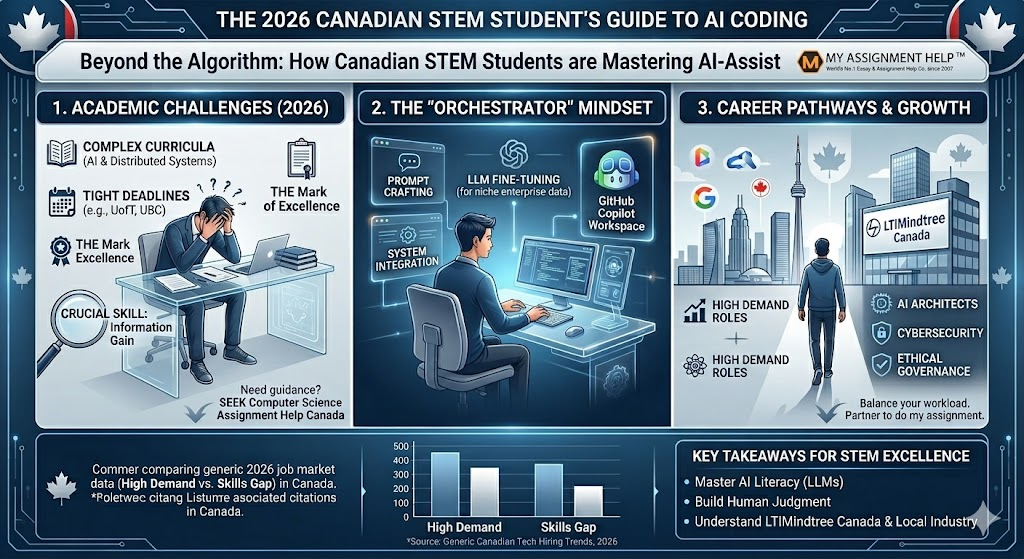
According to recent Robert Half Canada reports, nearly 48% of IT hiring managers plan to expand their teams this year, yet a staggering 50% report significant difficulty in finding skilled talent. This disconnect has placed immense pressure on students at institutions like the University of Toronto, UBC, and Waterloo. Major players like LTIMindtree Canada are increasingly looking for graduates who don’t just use AI, but understand the underlying mechanics—specifically LLM Fine-tuning to adapt models for niche enterprise data and governance standards.
[Image: A flowchart titled “The 2026 Canadian Tech Career Roadmap” showing the progression from Academic Theory → AI-Collaborative Coding → LLM Fine-tuning Mastery → Industry Placement at firms like LTIMindtree.]
As coursework becomes more complex to mirror these industry shifts, the academic burden on students has reached a breaking point. Navigating the nuances of machine learning and distributed systems often requires specialized mentorship. This is why many top-tier students seek out Computer Science Assignment Help in Canada to bridge the gap between theoretical lectures and the high-level practical execution required in today’s market.
Mastering the “Orchestrator” Mindset
In 2026, the term “vibe coding” has matured. It describes a workflow where AI generates and refactors code in real-time while the human developer acts as the “orchestrator.” Platforms like the GitHub Copilot Workspace have revolutionized this by allowing students to move from a natural language plan directly to a synchronized code implementation across entire repositories. This shift requires a new mix of skills:
- Prompt Crafting & Logic Design: The ability to give precise, high-level instructions to AI agents.
- LLM Fine-tuning: Understanding how to refine pre-trained models with task-specific data to improve accuracy for local Canadian business applications.
- Governance & Ethics: Ensuring that AI-generated code meets Canadian privacy standards (such as FIPPA) and ethical guidelines.
However, the rapid pace of these changes can leave even the brightest minds feeling underwater. When local deadlines pile up alongside internship applications for roles at LTIMindtree Canada or Shopify, it is common for a student to look for a professional to do my assignment so they can focus on high-impact networking and specialized project work.
See also: Advanced Systems Digital 4122148544 Firm Network Technology
Ethical Integration: The 2026 TEQSA and UFV Standards
Canadian universities have responded to the AI boom by embedding “AI Literacy” into the foundational curriculum. Guidelines from the University of the Fraser Valley (UFV) and Universities Canada emphasize that AI should amplify innovation, not replace critical thinking. Students are now encouraged to disclose their use of generative tools, focusing on the process of learning—such as how they used LLM Fine-tuning to solve a specific problem—rather than just the final code block.
Key Takeaways for 2026 STEM Students
- Embrace AI Literacy: Don’t fear the tools; master them. Understanding how to navigate a GitHub Copilot Workspace is now as fundamental as understanding HTML was in 2010.
- Specialize in Fine-tuning: Moving beyond “off-the-shelf” AI by learning LLM Fine-tuning will make you a prime candidate for top-tier firms like LTIMindtree.
- Prioritize Critical Thinking: Counteract AI reliance by manually verifying every suggestion.
- Focus on Soft Skills: Employers in 2026 prioritize emotional intelligence, adaptability, and problem-solving—skills AI cannot yet replicate.
Frequently Asked Questions (FAQ)
Q1: Is using AI for coding considered cheating in Canadian universities?
In 2026, most institutions permit AI use if it is disclosed and used as a “learning assistant” rather than a replacement for original thought. Always check your specific department’s academic integrity policy.
Q2: What is the benefit of learning LLM Fine-tuning for a student?
It allows you to customize AI models for specific tasks, which is a highly sought-after skill by Canadian enterprises looking to secure their data and improve model accuracy.
Q3: How does LTIMindtree Canada view AI skills in new hires?
Companies like LTIMindtree prioritize candidates who demonstrate “AI-fluency”—the ability to use AI tools to accelerate development while maintaining high standards of code quality and security.
Author Bio
Dr. Aris Thorne is a Senior Content Strategist and Academic Consultant at MyAssignmentHelp. With over a decade of experience in the Canadian higher education sector, Dr. Thorne specializes in the intersection of AI ethics and technical writing. He has helped thousands of students navigate the complexities of 2026 SEO standards and technical documentation.
Sources & References:
- Statistics Canada: “Analysis on employee skills gaps, Q1 2026”
- Robert Half Canada: “2026 Tech Hiring Trends Report”
- GitHub Education: “The Impact of Copilot Workspace on Student Productivity (March 2026)”
- LTIMindtree Annual Report: “Digital Transformation & AI Initiatives in Canada 2026”
- UFV AI Task Force: “Guiding Considerations for Generative AI in Education (January 2026)”